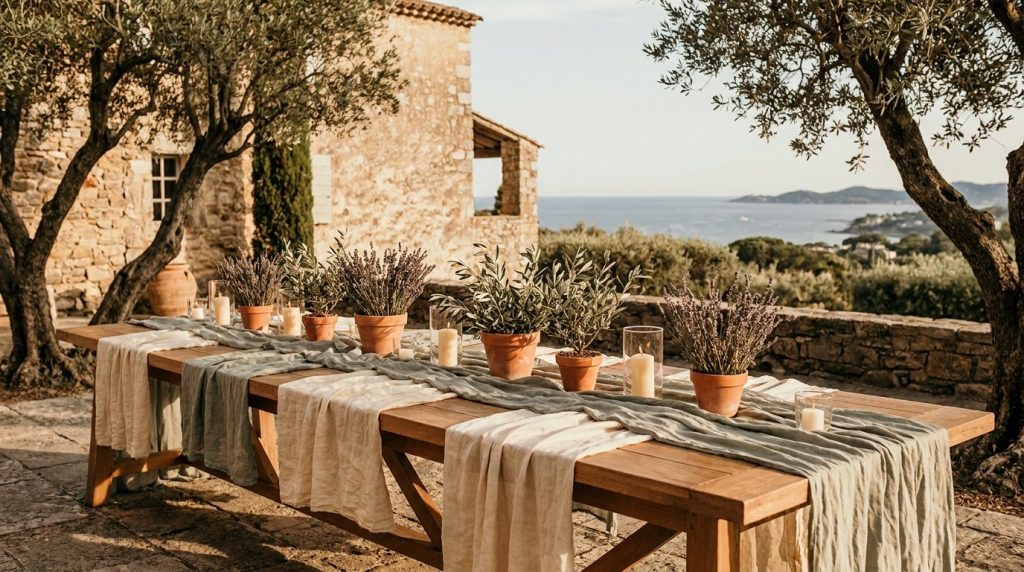
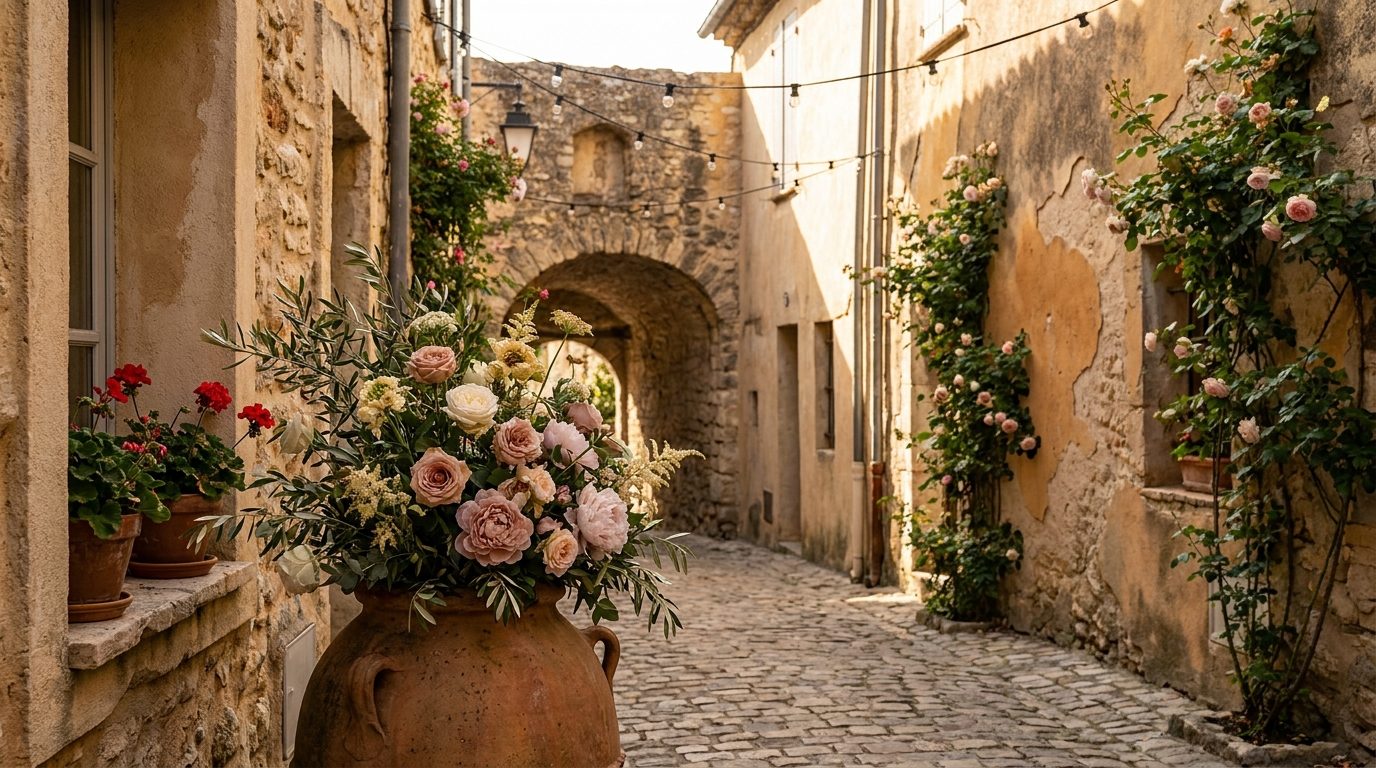
The flowers at a Provençal wedding aren’t decoration, they’re context. Lavender spilling from terracotta urns, peonies heaped in vintage baskets, olive branches trailing from ceremony arches: the right florist doesn’t just arrange flowers, they translate the landscape into your celebration.
This guide cuts through the noise. We’ve curated eight florists who work regularly in Provence, each with a distinct style, a track record with international couples, and the professionalism to deliver when you’re coordinating from London, New York, or Sydney.
planning a destination wedding in Provence
How to Choose a Wedding Florist When You’re Planning from Another Country
Distance adds friction to every vendor relationship but it adds the most to floristry. Unlike a caterer who you can judge by a tasting menu, or a photographer whose entire portfolio is visible online, a florist’s work lives and dies in the execution: the freshness of the stems on the day, the precision of the arrangements, the ability to adapt when the peony wholesaler is short.
What to look for in a remote florist relationship:
- Local sourcing network : florists who buy from the Marché aux Fleurs in Nice or work with farms in the Var valley will reliably source what they promise
- Experience with international couples : they need to be comfortable conducting consultations via video call and producing detailed mood boards in English
- Transparent pricing : request an itemised quote, not a package. You should know exactly what you’re paying for per table, per arch, per bouquet
- Day-of coordination : confirm they handle setup and breakdown themselves rather than subcontracting to a team you’ve never spoken with
- Portfolio depth : one or two beautiful weddings could be luck. Eight to ten consistent ones tell you more
The florists below have all been vetted against these criteria.
Provence’s Natural Floral Palette
Before you brief a florist, it helps to speak the language of the region. Provence has one of the most distinctive natural palettes in Europe, and the best wedding florists here lean into it rather than fighting it with imported tropical blooms.
Signature materials you’ll find in Provençal arrangements:
- Lavender : iconic, intensely fragrant, and available dried year-round or fresh from late June through August
- Peonies : the star of late spring weddings (May–June), dramatic and romantic in blush, coral, and white
- Roses de Grasse : old-garden varieties grown in the perfume heartland, with a looseness that no florist school can fake
- Wild fennel and olive branches : structural, silver-grey foliage that anchors any arrangement and photographs beautifully
- Mimosa : vivid yellow clouds in January and February, spectacular for winter weddings
- Sunflowers : bold and joyful from July through September
- Cosmos, scabiosa, sweet peas : the wildflower tier, perfect for bohemian and garden-party aesthetics
The region’s colour story runs from dusty purple through soft gold and terracotta, a palette that pairs naturally with stone venues, linen tablecloths, and the warm Provençal light.
8 Recommended Wedding Florists in Provence
These florists cover a range of styles and budgets. All work with English-speaking international couples.
1. Les Fleurs de Nathalie – Aix-en-Provence
Style: Romantic garden, abundant and slightly wild, think overflowing urns and loose bouquets that look gathered, not arranged. Price range: €€€ (ceremony + reception from ~€4,500) Portfolio note: Particularly strong at mas and château weddings. Regularly features in Vogue Mariage editorials.
2. Atelier Floral Mathilde – Luberon
Style: Minimalist and architectural. Structural foliage, negative space, earthy tones. Suits modern couples who want elegance without excess. Price range: €€€€ (bespoke from €6,000+) Portfolio note: Best portfolio for indoor/evening receptions with dramatic lighting design.
3. La Pivoine Sauvage – Gordes
Style: Peony-obsessed, pastoral, and genuinely seasonal. Mathilde refuses to source out-of-season flowers, which means incredible quality and honest limitations. Price range: €€ (packages from €2,200) Portfolio note: Excellent for smaller weddings and elopements. Limited availability June–July.
4. Studio Botanique – Marseille
Style: Contemporary, textural, influenced by the garrigue, wild thyme, rosemary, sage integrated into every arrangement. Price range: €€€ (from €3,800 for full-day floristry) Portfolio note: Strong track record at urban venues and converted industrial spaces.
5. Fleurs du Luberon – Apt
Style: Classic French with a nod to the English garden. Roses, ranunculus, sweet peas. Reliably beautiful, consistently executed. Price range: €€ (wedding packages from €2,500) Portfolio note: The most consistent across different budget levels. Ideal if your priority is reliability over distinctiveness.
6. Rosier & Co – Saint-Rémy-de-Provence
Style: Wildflower and meadow aesthetic. Loose, unstructured, seasonal. If you want arrangements that look like someone beautiful walked through a field, this is the studio. Price range: €€ (from €1,800) Portfolio note: Works well with bohemian and rustic venues. Less suited to formal château settings.
7. Atelier Olivier – Avignon
Style: Heritage luxury. Think royal wedding references with Provençal materials. Cascading bouquets, elaborate ceremony arches, statement tablescapes. Price range: €€€€€ (full-day floristry from €10,000) Portfolio note: For couples who want something truly show-stopping and have the budget for it.
8. Les Botanistes – Aix-en-Provence
Style: Sustainable focus, all local and seasonal, zero imported stems. The arrangements are beautiful precisely because of the constraint. Price range: €€ (from €2,000) Portfolio note: Growing reputation in the eco-conscious wedding market. Best for late spring and summer dates.
L&J introduces you only to florists who share your vision. Ask us.
Seasonal Flower Availability in Provence
Provence’s flower calendar is tighter than most florists will admit upfront. This table gives you the honest picture:
| Flower | Peak Season | Notes |
|---|---|---|
| Peonies | May–June | Two to three weeks at peak; book early |
| Lavender (fresh) | Late June–August | Dried available year-round |
| Roses de Grasse | May–October | Best in June and September |
| Sunflowers | July–September | |
| Mimosa | January–February | Spectacular for winter weddings |
| Wildflowers (cosmos, scabiosa) | May–September | |
| Olive branches (foliage) | Year-round | |
| Sweet peas | April–June | |
| Ranunculus | March–May |
Key takeaway: May and June are the richest months. If you’re marrying in July or August, discuss with your florist what will genuinely be at its best, not what can be sourced from the Netherlands.
Questions to Ask Your Florist During a Video Call
A 30-minute call with a prospective florist should answer more than just “do I like their style?” These are the questions that separate a good florist from a great one:
- Where do you source your flowers? : Local farms and regional markets are the answer you want.
- Can you guarantee the specific flowers in my mood board? : Honest answer: they can’t, entirely. But they should explain their contingency process.
- Who handles setup on the day you personally, or a team? : If it’s a team, ask to meet them.
- Have you worked at my venue before? : Venue familiarity matters more than you’d think.
- What’s your approach if something arrives damaged or late from the wholesaler? : Their answer tells you everything about their crisis management.
- Can I see three or four full weddings in your portfolio, not just hero shots? : Detail shots, table settings, ceremony arches, bouquets, the full picture.
- What does your payment and cancellation structure look like? : Expect a 30–50% deposit, with the balance 4–6 weeks before the wedding.
FAQ
How far in advance should I book a wedding florist in Provence?
For peak season dates (May–September), book 12 to 18 months ahead. The best florists, particularly those with limited capacity, fill their calendars quickly. October through April weddings have more flexibility, 6 to 9 months is generally sufficient.
What does wedding floristry typically cost in Provence?
Budgets range widely. A simple, seasonal approach (bridal bouquet, a few centrepieces, ceremony décor) starts around €1,800–€2,500. A full-service luxury florist for a 100-guest wedding with elaborate tablescapes and a ceremony arch will typically run €6,000–€15,000+.
Can I use flowers I’ve seen in my Pinterest board?
Yes, with caveats. Your florist will tell you which flowers in your inspiration images are realistic for your date and region. Expect substitutions, the goal is to capture the mood, not necessarily the exact stem.
Do Provençal florists work with international couples who can’t visit before the wedding?
Most experienced florists in the region are set up for remote collaboration. Expect to work via video call, detailed written briefs, and mood boards. A physical walkthrough of the venue isn’t always possible, but many florists will visit the venue on your behalf and send photos.
What’s the difference between a florist and a floral designer?
In the context of weddings, a floral designer takes on a broader creative role, they consider the overall visual narrative of the day, work closely with your planner and décor stylist, and often handle more than just flowers (dried botanicals, foliage installations, etc.). Most on this list operate as full floral designers.